
Let's get one thing straight. "I'm just not photogenic" is not a personality trait. It's a skill gap.
The reason you hate every photo of yourself isn't because the camera hates you. It's because you've never learned how cameras actually work, how light hits your face, or how to relax when a lens is pointed at you. And that's fine. Nobody teaches this stuff.
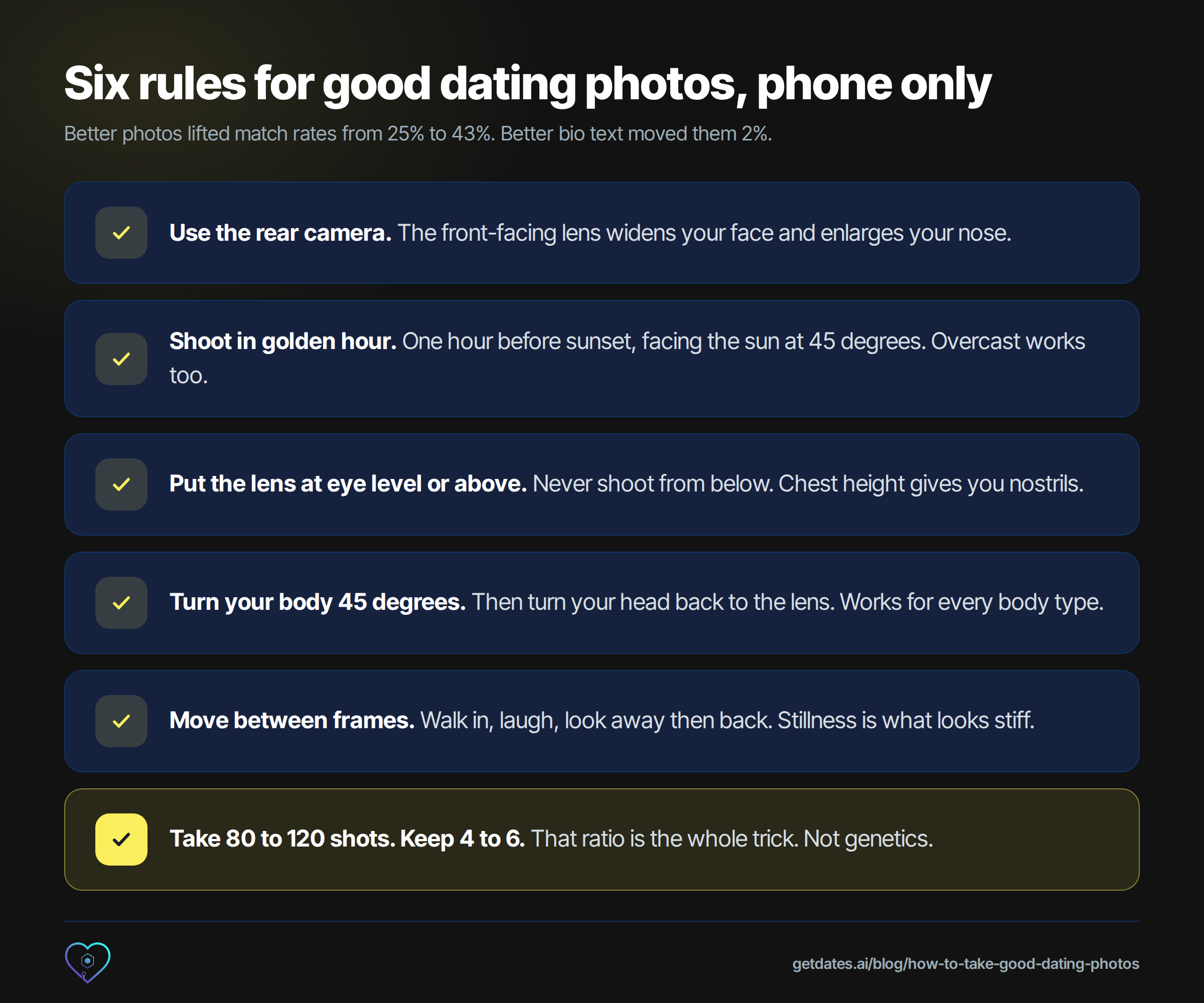
But here's the problem: your photos are making or breaking your dating life right now. If you want more matches on dating apps, this is where the work is. Research shows that improving photo attractiveness by one standard deviation increased matching rates from 25% to 43%. Meanwhile, improving your bio text barely moved the needle at 2%. Your words matter. But your photos matter about 20x more.
So if you're sitting on two blurry selfies and wondering why your matches are dead, this is the guide that fixes that.
Pre-Shoot Checklist
- Charge your phone fully and clear storage space for 100+ photos
- Clean your rear camera lens (yes, this matters more than you think)
- Pick your shoot time: golden hour (1 hour before sunset) or a bright overcast day
- Find a location with good natural light and a clean, uncluttered background
- Lay out 2 to 3 outfit options that fit well and look good on you
- Grab a phone tripod or stack books on a table to prop your phone at eye level
- Set your phone to portrait mode and turn off the flash
- Plan to take at least 20 to 30 shots per setup and keep only the best 1 to 2
If you want the full breakdown on which photo types perform best and what order to put them in, our best dating profile photos for men guide covers that in detail. This article is about the actual process of getting those shots, even when you feel awkward doing it.
Why You Think You're "Not Photogenic"
There's actual science behind why you hate photos of yourself. It's called the mere exposure effect. Your brain is used to seeing your face in the mirror, which is a reversed image of how you actually look. When you see a photo (which shows the non-reversed version), it looks "off" to you, even though that's what everyone else sees all the time.
In other words, the version of you that looks weird in photos is the version of you that everyone else already knows and is completely fine with. You're not ugly in photos. You're just unfamiliar with that version of your face.
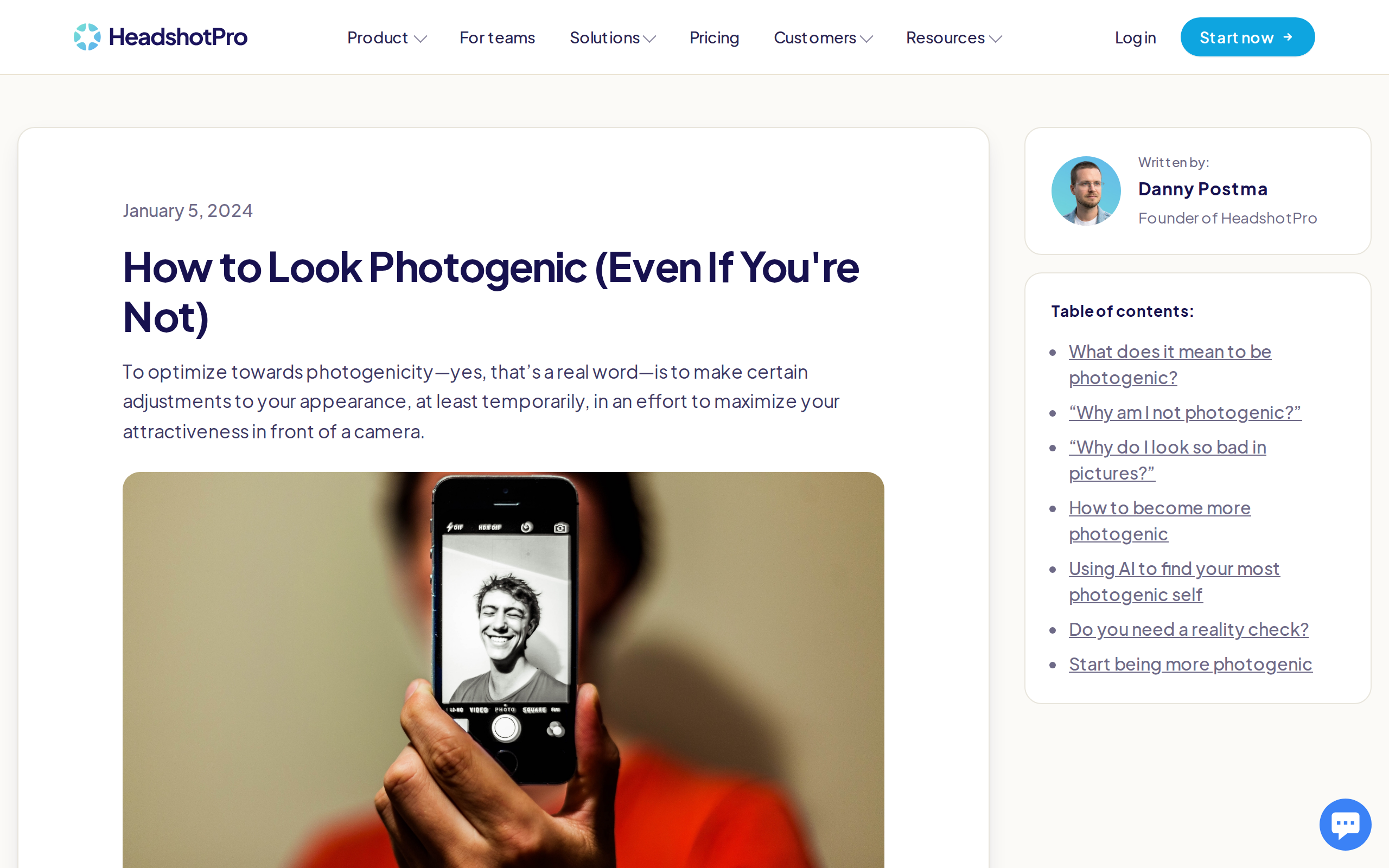
HeadshotPro's research confirms that being photogenic is a learned skill, not a genetic gift. Professional models look great in photos because they've taken thousands of them. They've figured out their angles, their expressions, the way light works on their face. You can learn the exact same things in an afternoon.
So stop telling yourself you're not photogenic. You're just unpracticed.
The Only Gear You Need: Your Phone
You do not need a $3,000 camera. Every smartphone made after 2021 shoots sharp enough for a dating profile. The rear camera is what matters, not the front-facing selfie camera, because rear cameras have significantly better resolution and less lens distortion.
Here's your minimal gear list:
- Your phone's rear camera in portrait mode (blurs the background, draws attention to you)
- A phone tripod ($15 on Amazon) or a stack of books to prop your phone at eye level
- A 3 or 10-second timer (built into every phone camera app)
- Optional: A Bluetooth remote ($8 to $12) so you can take shots without running back and forth
That's it. If you want to get fancy, a $20 ring light gives you studio-quality face lighting for indoor shoots. But natural light is free and usually better.
Never Use the Front Camera
The front-facing selfie camera distorts your features because of its wide-angle lens. It makes your nose look bigger, your face look wider, and your proportions look off. This is one of the biggest reasons guys think they're not photogenic. Always use the rear camera with a timer or remote.
Lighting: The One Thing That Changes Everything
Lighting is the single biggest difference between a photo that looks professional and one that looks like a mugshot. You can have perfect hair, a great outfit, and a killer jawline, and bad lighting will make all of it look terrible.
Here are the three lighting setups that actually work, ranked by how good they'll make you look.
Lighting Setups Ranked
| Setup | Difficulty | Cost | Result Quality | When to Use |
|---|---|---|---|---|
| Golden hour outdoors | Easy | Free | Best possible | 1 hour before sunset, face the sun at a 45-degree angle |
| Overcast day outdoors | Easy | Free | Excellent | Anytime on a cloudy day, clouds act as a giant diffuser |
| Window light indoors | Easy | Free | Very good | Stand 1 to 2 meters from a large window, face the light |
| Ring light indoors | Easy | $15 to $30 | Good | Evenings or rooms with no windows |
| Two lamps at 45 degrees | Medium | $0 (you have lamps) | Good | Night shoots, place one lamp on each side of your face |
Golden Hour: The Cheat Code
Photos taken during golden hour are consistently rated as more attractive. The warm, directional light smooths out skin texture, adds warmth to your complexion, and creates natural shadows that define your jawline and cheekbones.
Golden hour happens twice a day: about an hour after sunrise and an hour before sunset. The sunset one is easier to catch. Just go outside, face the sun at roughly a 45-degree angle (so the light hits one side of your face more than the other), and shoot.
Window Light: The Indoor Alternative
If you can't shoot outside, stand 1 to 2 meters from a large window during daylight hours. Face the window so the light falls evenly across your face. This gives you soft, flattering light that's almost as good as golden hour.
Avoid overhead ceiling lights at all costs. They cast harsh shadows under your eyes and nose that make you look tired and older than you are.
The Two-Lamp Trick
If you're shooting at night and don't have a ring light, place two desk lamps at 45-degree angles on either side of your face, about 3 feet away. Drape a white t-shirt or thin cloth over each lamp to diffuse the light and soften the shadows. This eliminates the harsh single-source look that makes home photos look amateurish.
Angles That Flatter Every Face Shape
Camera angle is the second biggest factor after lighting. A two-inch change in camera height can be the difference between "damn, who's that" and "is he okay?"
Camera height matters. Set your phone at eye level or slightly above. Holding the camera slightly above eye level and tilting your chin down slightly is almost universally more flattering because it reduces any appearance of a double chin and makes your eyes more prominent.
Never shoot from below. A camera pointed up at you from chest or waist height gives you unflattering nostrils, an enlarged chin, and a compressed forehead. This is the angle of accidental FaceTime screenshots, and it's never a good look.
The 45-degree rule. Turn your body about 45 degrees away from the camera instead of standing square to it. This creates a more dynamic, three-dimensional look and makes you appear leaner. Then turn your head back toward the camera. This is what photographers call the "three-quarter pose" and it works for basically every body type.
Distance from the camera. Stand about 6 to 8 feet from the camera for full-body shots, and about 3 to 4 feet for portraits. Too close and the lens distorts your features. Too far and you lose detail.
How to Look Natural When You Feel Like an Idiot
This is the real problem, isn't it? You know where to stand and how to set up the light, but the second that timer starts counting down, you freeze up. Your smile gets weird. Your posture goes stiff. You look like you're being held at gunpoint.
Here's how to fix that.
The Movement Trick
The best dating photos don't look posed. They look like someone caught you mid-moment. So actually create that moment.
Walk toward the camera. Laugh at something. Look down at your phone, then look up right as the timer fires. Adjust your jacket. Turn around and look back over your shoulder. Movement creates natural expressions that you can never recreate by standing still and trying to look natural.
Set your phone to burst mode or a 3-second timer on repeat, and just move. Out of 30 shots, 2 or 3 will have that effortless quality that makes people stop scrolling.
The Exhale Method
Before the timer goes off, take a deep breath and exhale slowly through your mouth. Right at the end of the exhale, close your lips into a soft, relaxed expression. This physically releases tension in your jaw, forehead, and around your eyes. It works because muscle tension is the number one killer of natural-looking photos.
Stop Trying to Smile on Command
Forced smiles look forced. Everyone can tell. The muscles around your eyes don't engage unless the smile is genuine, and the result is what psychologists call a "social smile" versus a real one.
Instead, think of something that actually makes you happy or laugh right before the shot. A funny memory, a joke from a friend, an absurd situation. Photofeeler's research on millions of ratings showed that whether you smile matters less than whether the smile is genuine. A natural, relaxed expression beats a forced grin every single time.
If smiling feels weird, go with a neutral expression with slightly relaxed eyes. Think "I just heard something interesting" rather than "say cheese."
The DIY Photo Shoot: Step by Step
Here's the actual process. Block off 45 minutes, put on some music, and treat it like a project instead of a performance.
Your DIY Photo Shoot Blueprint
- Set up your phone on a tripod or books at eye level in your first location (best natural light you have)
- Put on outfit one: your go-to look that you feel confident in
- Take 20 to 30 shots of a close-up portrait (face and shoulders, natural expression)
- Change location or background, take 20 to 30 full-body shots (standing naturally, not posed)
- Switch to an activity: cooking, playing guitar, reading, whatever you actually do for fun
- Take 20 to 30 shots while actually doing the activity (not posing with the prop)
- Change outfit if you want, move to a different location with different light
- Take another round of 20 to 30 shots with this new setup
- Review all photos and pick only the top 1 to 2 from each round
- Lightly edit your picks (brightness and contrast only, no filters) and upload to your profile
The volume approach matters. You're taking 80 to 120+ photos to end up with 4 to 6 keepers. That ratio is completely normal. Professional models shoot thousands of photos to get a handful of usable ones. The difference between you and a "photogenic" person isn't that they look good in every photo. It's that they take enough photos to guarantee a few great ones.
Quick Reference: What to Shoot
You need variety in your profile. Not six versions of the same pose in the same location.
Photo Types for Your Shoot
| Shot Type | What It Shows | How to Take It | Common Mistake |
|---|---|---|---|
| Close-up portrait | Your face, clearly | Rear camera, natural light, soft expression, eye contact | Using front camera or wearing sunglasses |
| Full-body shot | Your build and style | 6 to 8 feet from camera, someone else or timer | Mirror selfie or awkward posing |
| Activity photo | Your personality | Actually do the thing while timer runs on burst | Staging an activity you don't really do |
| Social photo | You have friends | Ask a friend to snap a candid at dinner or an event | Group shot where nobody can tell who you are |
| Dressed-up photo | You clean up well | Events, dinners, or just put on a good outfit | Looking stiff or uncomfortable |
For the full data on which photo types perform best and what order to put them in, check our best dating profile photos for men guide. It includes stats from Hinge, Zoosk, and Photofeeler on exactly how each type impacts your likes and messages.
Editing: Less Is More (Seriously)
Here's where guys mess this up. They take decent photos, then run them through four filters until they look like an Instagram influencer from 2016. It ranks with the other dating app photo mistakes that quietly cost you matches.
Research from Zoosk found that heavily filtered photos get significantly fewer messages. And 73% of dating app users wish heavy retouching was banned from profiles.
What to do instead:
Good Edits
- Bump brightness slightly if the photo is too dark
- Increase contrast a touch to make colors pop
- Crop to remove distracting background elements
- Straighten the horizon line if it's tilted
- Use your phone's built-in auto-enhance as a starting point
Bad Edits
- Skin-smoothing filters that erase texture and make you look plastic
- Color filters that change your skin tone (no, you don't need to look tan)
- Heavy saturation that makes everything look radioactive
- Face-slimming or jaw-widening tools (she'll see the real you on date one)
- Any edit that makes you look noticeably different from how you look in person
The goal is to correct technical issues (exposure, crop, straightness), not to redesign your face.
When DIY Isn't Enough
Look, not everyone has the patience or the setup to do a solid DIY shoot. And that's okay.
Professional photographers are one option. Passport Photo Online's study found that people who hired a photographer got 49% more matches, 48% more likes, and 43% more first messages. That's a significant jump. The downside: it costs $150 to $500, and some guys feel awkward posing for a stranger.
AI photo generators are another route. The technology has gotten surprisingly good at creating realistic dating photos from your existing selfies. If you're curious about the options out there, our AI dating photo generator comparison breaks down the major tools. And if you're wondering whether they actually work, we dug into the real data on whether AI dating photos actually deliver results.
Both approaches solve the same problem: getting high-quality photos without needing to master photography yourself.
Platform-Specific Adjustments
Different apps display photos differently, so your shoot strategy should account for where you're posting.
On Tinder, your first photo does almost all the work because most users never scroll past it. Invest the most effort into nailing that one close-up portrait, and see dating profile photo order for where the rest should sit. If you're optimizing specifically for Tinder, our AI photos for Tinder guide covers what performs best on that platform.
On Hinge, photos are interspersed with prompts, so each photo is a potential conversation starter. Activity photos work especially well because they give her something specific to comment on. Your AI photos for Hinge can be optimized for exactly this format.
On Bumble, she messages first. That means your photos need to give her an easy opening line. A photo of you cooking, hiking, or doing something slightly unusual is basically writing her first message for her. Check our best dating apps breakdown if you're still deciding which platforms to focus on.
The Bottom Line
Being photogenic is not something you're born with. It's something you learn by understanding four things: how light works, where to put the camera, how to relax your face, and how to take enough shots that the numbers work in your favor.
Block off 45 minutes this weekend. Set up your phone. Take 100 photos. Keep the best five.
That's the entire secret. No genetics required.